The Unification Church is selling its historic Washington chapel.
The church is selling the landmark Washington Chapel in Adams Morgan to a condo developer and evicting the congregation members who had been living inside, two of whom fought the case in court without a lawyer. A look at the record, the fight to stop the sale, and the building's stranger history.
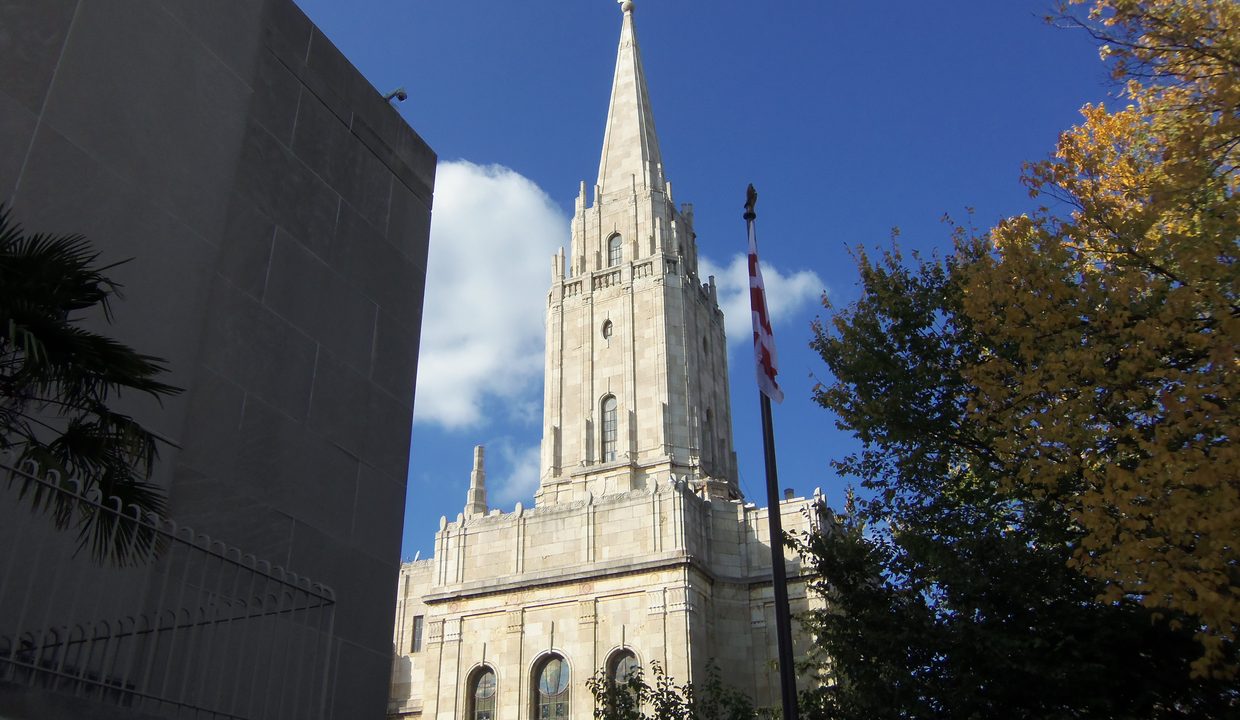
Photo by Farragutful, licensed CC BY-SA 3.0, via Wikimedia Commons.
- 01 The building
- 02 The sale
- 03 The members fighting it
- 04 The eviction
- 05 The building's harder history
- 06 The wider picture
Jump to a section, 6 in this article open ↓
In Washington's Adams Morgan neighborhood, on the corner of 16th Street and Columbia Road NW, stands a stone church that most passersby would take for a small Mormon temple. It nearly was one. The building belongs to the Unification Church, and the church is selling it, even as some of its own members fight to stop the sale and the people who had been living inside are put out.
The building
The Washington Chapel was built between 1930 and 1933 as the Latter-day Saints' first large permanent house of worship east of the Mississippi in nearly a century, its 163-foot tower and birdseye-marble veneer modeled on the Salt Lake Temple; the District designated it a historic landmark in 1964, and the Unification Church bought it in 1977. 1 It ran for decades as the church's Washington congregation, the original stained-glass windows and an exterior mosaic of Jesus Christ kept in place. The building’s landmark record, with photographs, is kept by the DC Preservation League.
The sale
The church is selling the property to Dila Development, which has brought condominium plans before the District's Historic Preservation Review Board, scaling an initial nine-story proposal down to six stories and 34 units after community pushback. 2 Reporting has put the sale in the range of six to seven million dollars. 3 Renderings of the proposed development have been published.
The members fighting it
Not everyone connected to the church supports the sale. A “Protect This Church” campaign appeared on the building, and a group of members has tried to block it, at one point offering to buy the chapel themselves at the same six-to-seven-million-dollar asking price. 3
The eviction
In legal form, the church's case was a commercial one. The complaint it filed in July 2024 sought possession under the District's commercial-property procedure, and its position was blunt: the occupants were “not residential tenants” and had “no legal right to inhabit the Property.” 4
The court papers themselves record that the occupants and other members of their congregation “have been holding religious worship services” in the building, and some had been living there. A church representative told the press they were there “without the authorization of the Unification Church leadership.” Both framings are in the record; the undisputed fact is that the people the church moved to remove were members of its own congregation.
How the case ended split the occupants in two. Five of them, represented by a lawyer, signed a consent judgment in May 2025: they would leave by the end of June, and the church would pay each of them four thousand dollars “to help them find lodging.” The other two had no lawyer; representing themselves, they asked the court more than once for more time, to find legal representation and to raise the financing to buy the building themselves, at one point requesting a full year. The court denied the continuances; the trial went forward with the two of them unrepresented, and they lost. A handwritten motion for judicial review was denied weeks later. 4
Then the matter went quiet for nearly a year. The church held its possession judgment from May 2025 but did not move to enforce it until April 2026, when it filed for a writ of restitution; an initial writ was rejected on a paperwork technicality, and a corrected one issued on May 22, 2026. 4 A week later the church sent its “Final Notice of Eviction,” fixing the Marshals' date: June 24, 2026. 5
The building's harder history
A sale and an eviction are not the strangest things this church has seen. In 1987 and 1988 the Unification Church was convulsed by the episode known as “Black Heung Jin Nim”: a Zimbabwean member, Cleopas Kundioni, whom Sun Myung Moon and senior officials accepted as the living spiritual channel of Moon's son Heung Jin, who had died in a 1984 car crash at seventeen. 6 Authorized by Moon to travel and hear members' confessions, Kundioni administered beatings as “indemnity” for confessed sins; at the church's Belvedere estate in New York he beat Moon's chief lieutenant Bo Hi Pak, the founder of The Washington Times, so badly that Pak needed surgery to relieve pressure on his brain. 7
Damian Anderson, a church member who has written that he witnessed the DC sessions firsthand, describes the violence reaching the Washington congregation as well: at the DC church, he writes, the doors were locked, members were handcuffed with golden handcuffs, and people were struck with a baseball bat. 8
A dark chapter in the history of our church, which I hope is never repeated.
8
The wider picture
The chapel is not the only major American property the movement has parted with recently. In January 2024 it sold the former Unification Theological Seminary in Barrytown, New York, a 260-acre Hudson River campus that had been the church's American base since the 1970s, to Bard College for about fourteen million dollars. 9 Other large holdings remain in the church's hands, and contested: through 2024 and 2025 it fought in court to keep Manhattan's New Yorker Hotel against a fraudulent claim on its deed. 10 What the DC sale marks, then, is not a wholesale liquidation, but the loss of another of the movement's landmark American buildings.
For the people who filled them, these buildings were never only real estate. They were congregations and gathering places, in many cases built up and sustained over decades by members' own giving and volunteer labor. An institution that asks that kind of devotion might be expected to treat the people, and the neighborhoods, it leaves behind with some care as it consolidates. What the record here shows instead, a congregation's hall sold over its objections, some occupants paid to leave and the rest taken to a U.S. Marshals eviction, reads to us less like a family looking after its own than like an organization clearing an asset. You may read it differently. This is how it looks from where we sit.
References.
- 1 Historic American Buildings Survey, Historic American Buildings Survey: Washington Chapel (HABS DC-539) · Library of Congress.
- 2 1610 Columbia Road NW (development pipeline) · UrbanTurf.
- 3 Tad Walch, Washington Chapel sale plans and opposition · Deseret News (2025).
- 4 HSA-UWC v. [tenant defendants], No. 2024-LTB-007019 (D.C. Super. Ct., Landlord & Tenant Branch) · Superior Court of the District of Columbia.
- 5 HSA-UWC Final Notice of Eviction, 1610 Columbia Road NW · Holy Spirit Association for the Unification of World Christianity (2026).
- 6 Theological Uproar in Unification Church · The Washington Post (1988).
- 7 Moon church says spirit of leader's dead son has returned · United Press International (1988).
- 8 Damian Anderson, Black Heung Jin Nim in DC · tparents.org (Unification archive).
- 9 Unification Theological Seminary in Barrytown sold to Bard College · Mid Hudson News (2024).
- 10 Man indicted over fraudulent New Yorker Hotel deed · NBC News (2024).